































News details Media center



1 Nov’ 2025
13 Arab Nations Marked Their Presence Across 19 Editions with 4 Notable Achievements in the FIFA U-17 World Cup
Doha: Since the inaugural edition in China in 1985, a total of 84 national teams have appeared in the FIFA U-17 World Cup, whose 20th edition (FIFA Qatar 2025) will kick off on Monday at Aspire Zone, running until November 27, with the final to be played at Khalifa International Stadium.
The FIFA U-17 World Cup Qatar 2025 will be the seventh edition hosted in Asia, following previous tournaments held in China (1985), Japan (1993), South Korea (2007), UAE (2013), India (2017), and Indonesia (2023).
Throughout the tournament’s history, 13 Arab nations have qualified for the finals — Qatar, Saudi Arabia, Bahrain, Tunisia, Morocco, Egypt, Oman, Syria, Iraq, Yemen, Algeria, Sudan, and the UAE.
Arab teams from Asia have shone particularly in this age category, producing four standout achievements: Saudi Arabia won the 1989 title in Scotland, while Oman, Qatar, and Bahrain each reached the semifinals once.
Qatar, the 1990 AFC U-17 champions, holds the record for most appearances by an Arab team, having qualified seven times for the World Cup — their last appearance being in 2005. The young Maroons will make their eighth World Cup appearance as hosts when they open the 2025 edition against Italy on Monday at Aspire Field 7.
Qatar debuted alongside Saudi Arabia in the first edition and achieved their best result in Italy 1991, finishing fourth after losing to Argentina on penalties (1–4) in the third-place match.
The greatest Arab achievement, however, came in 1989, when Saudi Arabia captured the FIFA U-17 World Cup title, becoming the first Arab and Asian nation ever to win a FIFA competition. The Saudis defeated Bahrain 1–0 in the semifinal and overcame hosts Scotland 5–4 on penalties in the final after a 2–2 draw.
Saudi Arabia had advanced from the group stage with four points (draws with Portugal and Guinea, and a 1–0 win over Colombia) before eliminating Nigeria on penalties (2–0) in the quarterfinals.
Meanwhile, Bahrain finished fourth after losing 0–3 to Portugal in the third-place playoff. The Bahrainis had topped their group with five points following wins over Cuba (3–0) and Ghana (1–0) and a draw with Scotland (1–1). They also stunned Brazil in the quarterfinals, winning 4–1 on penalties after a goalless draw.
Oman also made a historic run in Ecuador 1995, finishing fourth after losing 0–2 to Argentina in the third-place match.
In total, Arab nations have played 112 matches in previous U-17 World Cups, achieving 35 wins, 25 draws, and 52 losses, while scoring 137 goals. Among them, Algeria, which participated only once (Nigeria 2009), remains the only Arab team not to score a goal, having lost all three group matches.
Tunisia, which has competed three times, has six wins and five losses, reaching the round of 16 twice and exiting the group stage once.
The upcoming FIFA U-17 World Cup Qatar 2025 will feature six Arab teams: Qatar, Saudi Arabia, UAE, Morocco, Tunisia, and Egypt.
According to the draw:
Qatar, hosts and 1991 semifinalists, head Group A alongside Italy, South Africa, and Bolivia.
Morocco, quarterfinalists in Indonesia 2023, are in Group B with Japan, New Caledonia, and Portugal.
UAE, who reached the round of 16 in Nigeria 2009, compete in Group C with Senegal, Croatia, and Costa Rica.
Tunisia are in Group D with Argentina, Belgium, and Fiji.
Egypt, hosts of 1997, are in Group E with England, Venezuela, and Haiti.
Saudi Arabia, 1989 champions, will play in Group L against Mali, New Zealand, and Austria.
The Qatar 2025 tournament will feature a record 48 teams, divided into 12 groups of four. The top two teams from each group, along with the best eight third-placed teams, will advance to the round of 32. Across 25 days, 104 matches will be held at eight Aspire Zone venues, culminating in the final at Khalifa International Stadium.
This edition marks the first of five consecutive FIFA U-17 World Cups to be hosted by Qatar, as the tournament shifts from a biennial to an annual format, reaffirming Qatar’s position as a global hub for youth football development.
Media Kit:


More NEWS
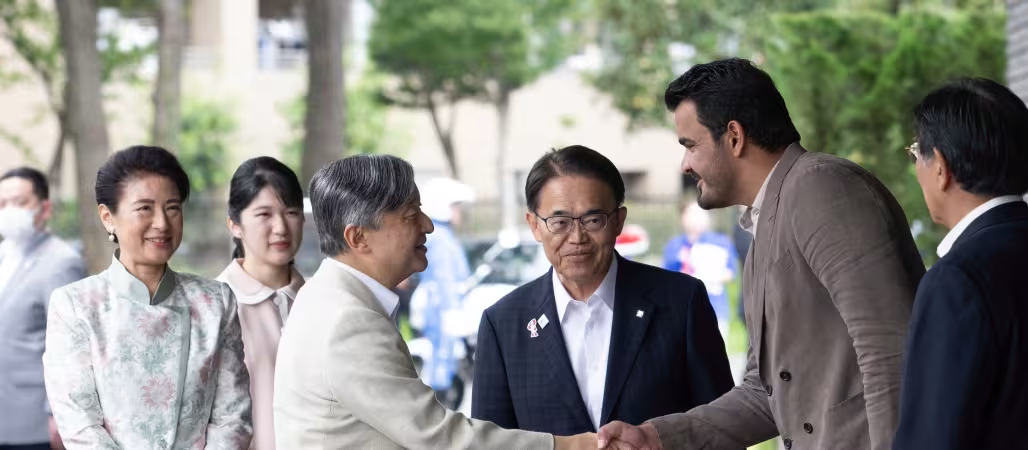
OCA President Welcomes Emperor and Empress of Japan at Equestrian Jumping Competition


SC showcases Qatar’s volunteering legacy at Bayt Qatar in the Asian Games 2026
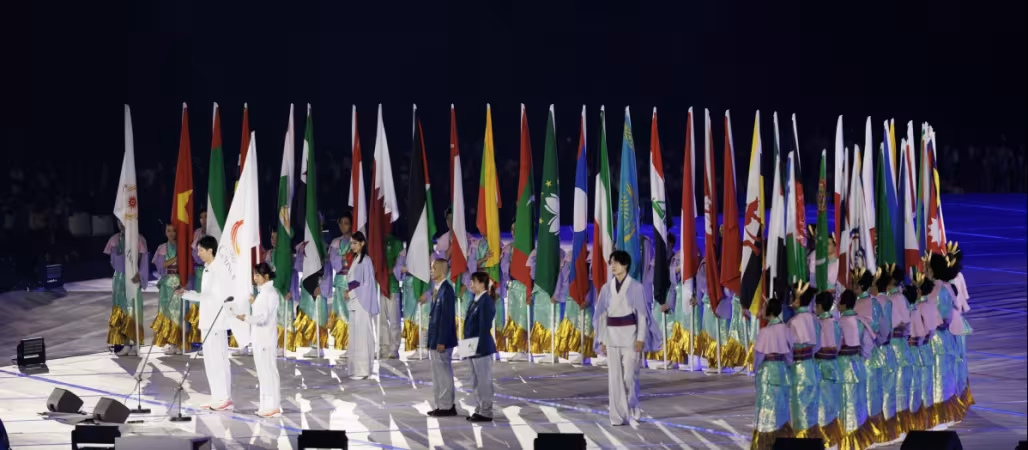
Qatar to Receive Asian Games Flag, Marking the Start of the Journey to Doha 2030

Qatar Delegation Celebrates Padel and Beach Volleyball Golds and Wrestling Bronze