






























All News

Team Qatar to seek its First Glory in Arab Cup
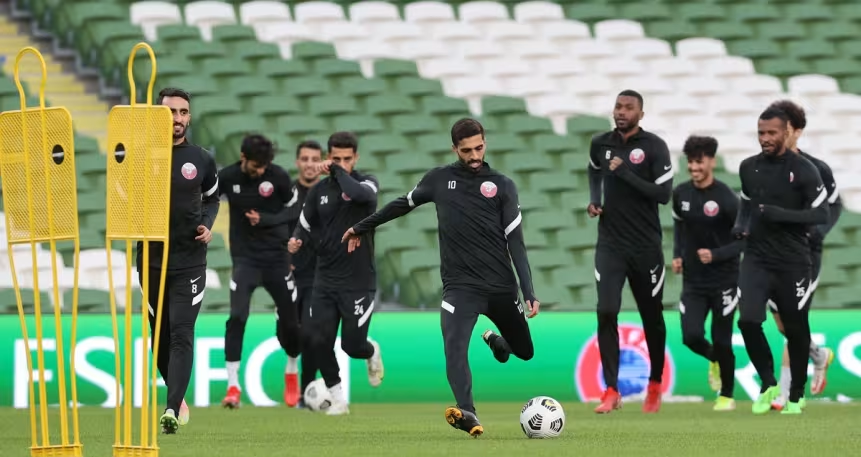
DOHA - The Qatari national team, the "Asian Champion", is looking for the title of the Arab Cup 2021, which Doha will host its competitions for the second time in its history from November 30 to December 18, where the opportunity will be in favor of Qatar regarding the land and the public factors to embrace his first title in his third participation in the tournament.
The Arab Football Cup returns to the fore again this year after a nine-year hiatus, the last Arab Cup was held in 2012 in Saudi Arabia in its ninth edition, and the Moroccan team won its title after defeating its Libyan counterpart, so that the Moroccan team won the first title in its history.
The current generation of the Qatari national team will be on a date with writing a new history of Qatari football, hoping to culminate in the title a year before Qatar hosts the most important sports event in the world, the "2022 World Cup".
The Qatari team did not participate in most of the Arab Cup tournaments, and was satisfied with being present in only two of the past nine editions, Qatar participated in the fourth edition in 1985 in Saudi Arabia, and the seventh edition in Qatar 1998.
Adel Khamis and Mubarak Mustafa, are among the most prominent stars of the Qatari team in the Arab Cup, specifically in the seventh edition in 1998.
The lack of Qatar's participation in the Arab Cup affected the emergence of many stars, but the situation may differ in the next edition hosted by Doha, especially with the possibility of the Spanish coach Felix Sanchez inclusion in a number of emerging players in the team's list during the upcoming tournament, which Qatar aspires to win its title and not miss the opportunity.
The Qatari team will start its campaign against Bahrain at the "Al Bayt " the World Cup Stadium on November 30, then Qatar will meet on December 3, in the third confrontation Qatar will meet its Iraqi counterpart on December 6.
The Qatari team prepared for this special event through a long journey of preparations, which included many participations, in the Copa America, as well as its distinguished appearance by reaching the semi-finals in the Gold Cup, as well as its positive participation in the European qualifiers for the World Cup (as a guest of honor without counting its results), therefore, the players will spare no effort to win their first title in the tournament.
The tournament will be a real test for Qatar, to determine its readiness to host the 2022 World Cup, and determine Qatar team players readiness for global entitlement.
The Arab Cup will be the ideal rehearsal that the teams are looking for to assess their level and try to correct mistakes, as the participation of African countries will positively affect the technical level, while creating a strong competitive atmosphere.
The final match of the Arab Cup will be held on December 18, in conjunction with Qatar National Day.
Teams have been divided into four groups, with top two teams from each group will qualify for the quarter-finals.
Group A of the FIFA Arab Cup consists of Qatar, Iraq, Oman and Bahrain. Group B consists of Tunisia, UAE, Syria and Mauritania. Group C consists of Morocco, Saudi Arabia, Jordan and Palestine. Group D will include Algeria, Egypt, Lebanon and Sudan.
The matches will be held at six of the eight World Cup venues including Al Bayt, Al Janoub, Ras Abu Aboud, Al Thumama, Education City and Ahmed bin Ali stadiums.
The Arab Cup returns in 2021 after a nine-year hiatus, under FIFAs supervision.
The last Arab Cup was held in Saudi Arabia in 2012, in which Morocco became champions after beating Libya 3-1 on penalties in the final match.
Qatar second time hosts of the tournament has organized major global sporting events across all sports and is set to present an exemplary and distinct FIFA Arab Cup. Qatar possesses the most modern sports facilities in the world and the capabilities that made it the center of international sports for many years.
The FIFA Council officially approved the 2021 Arab Cup during the 15th meeting of the Council held at its headquarters in Zurich in March 2021.
FIFA President Gianni Infantino confirmed that the approval of the Arab Cup by the FIFA Council in Qatar 2021 was among the events that Qatar will organize in preparation for the 2022 FIFA World Cup.
The Supreme Committee announced the implementation of the fan card system during the tournament, as all match ticket holders will have to issue a mandatory fan card to enter the tournament stadiums, which is a smart identification card that will allow fans to use public transportation for free during match days, and a smartphone application will be launched before the tournament. With the aim of enhancing the fan experience in Qatar. The tournament will witness the application of all preventive measures to ensure the health and safety of all participants in the competitions, due to the repercussions of Corona.
The first edition of the Arab Cup was hosted in Lebanon in 1963 when Tunisia were emerged as champions. The Iraqi national team is the most decorated side with four titles. Saudi Arabia was crowned twice, while Tunisia, Egypt and Morocco have claimed one title each.
Former Lebanese player Adnan Al Sharqi was the first player to score a goal in the tournament against Kuwait.
In 1964, the second edition of the FIFA Arab Cup was held in Kuwait City, from Nov. 13 to 20, with the participation of Kuwait, Jordan, Libya, Iraq and Lebanon only. Iraq came first with seven points, while Libya came in second place with six points.
The third edition of the championship was held in 1966 in Baghdad from April 1 to 10 with hosts winning the title. The Arab Football Cup was halted for 16 years and Iraq retained their title with a win over Bahrain in the final.
The fifth edition of the Arab Cup was held in the Jordanian capital, where in the final, Iraq defeated Syria on penalty shootouts.
Syria hosted the sixth edition of the Arab Cup, won by Egypt after defeating Saudi Arabia. The seventh edition of the Arab Cup was held in Qatar in 1998, when the Saudi team beat the hosts in the final.
The eighth Arab Cup tournament was held in 2002 in Kuwait City again, from Dec. 16 to 30, with the participation of ten teams which were divided into two groups.
In the final, Saudi Arabia defeated Bahrain with the golden goal, after the match ended in a goalless draw.
The ninth Arab Cup tournament was held in 2012 in Saudi Arabia again from June 22 to July 6, with the participation of 11 teams which were divided into three groups.
In the final match of the tournament, Morocco defeated Libya 3-1 by penalties shootouts, after the original and extra time ended in a draw, to win the first title in its history.

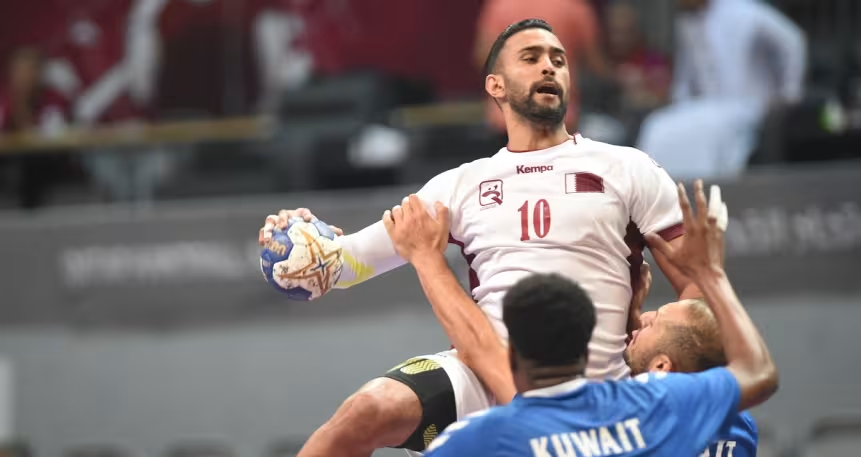

Team Qatar defeat Kuwait in Qatar International Handball Friendly Championship
Doha: Qatar got their preparations for the 2022 AHF Asian Handball Championship off to a flying start by defeating Kuwait 32-19 in the International Four-Nation Friendly Championship at the Al Duhail Indoor Arena on Tuesday.
The four-time Asian champions, playing their first competitive game since finishing eighth in the 2021 IHF World Championships in Egypt in January, displayed good coordination in both attack and defence.
Ahmad Madadi, Youssef Benali (both six goals), Frankis Marzo (five) and Rafael Capote (four) were Qatar’s main scorers. They combined well to lead the team’s raids and swiftly fell behind to defend in numbers.
Qatar’s Spanish coach Valero Rivera used the match to test different combinations by rotating the players. His experiments paid off as 12 Qatari players got their names on the scoreboard.
Qatar were always in firm control. With Frankis and Benali inflicting most of the early damage, the hosts led 18-13 at half-time. The team consolidated their lead in the second half and with 15 minutes left, led by 12 goals (27-15).
Except for Saleh (six) and Abdullah (four), none of the Kuwaiti players could make an impact. With Qatar’s 24-year-old goalkeeper Bilal Lepenica in good form, things became even more challenging for the Kuwaitis and they slipped to a big defeat.
Earlier, Iran got the better of Saudi Arabia 24-16 in the tournament opener.
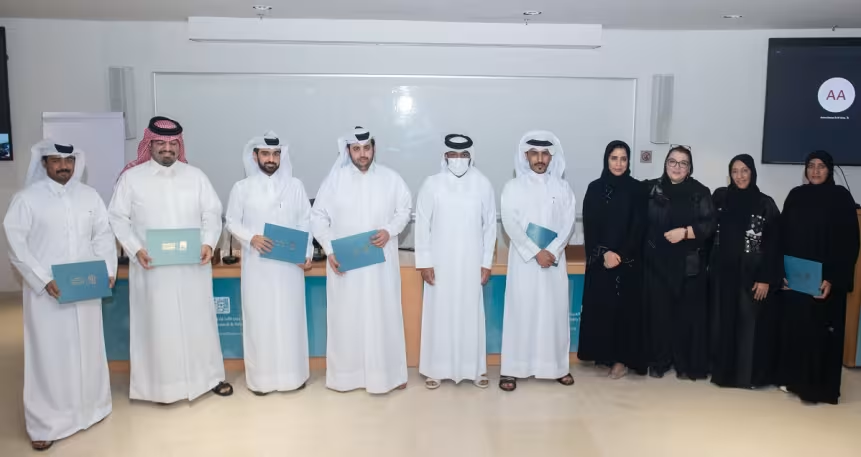
Second edition of talent management program concludes
Doha: The second edition of talent management program (Shadow President) organized by Excellence Center for Training and Consulting at Doha Institute for Graduate Studies was concluded on Saturday.
The training program brought together 25 employees from the different departments of the QOC.
The sixth phase of the training program focused lights on the relation between employees and manger and promoting the concepts of role model and inspiration.
The training program lecturer addressed the concept of role model and the importance of having role models from the local community to achieve the goals of Qatar National Vision 2030.
This program has brought modern content and methods in line with the center's tendency to provide modern quality program that respond to the needs of the QOC.
The Director of QOC Human Resources and Administrative affairs Maryam Al Kuwari, said “The program represented a continuation for the first edition of Talent Management program in 2019, as we believe that the human cadre is the primary resource of any institution and the most important element for its success.”
“The QOC seeks to develop a database for the second level employees to ensure that the supervisory functions approved within the organizational structure of QOC are secured, to promote concepts of excellence, to motivate all its staff to participate in them, to encourage positive competition among them and to develop their creativity, which reflect positively on institutional performance.” she added.


Othman Boularas wins bronze medal at World Taekwondo Championship
Doha: Qatar's national team player Othman Boularas won the bronze medal in the Online World Taekwondo Poomsae Championship "Challenge 3", organized by the International Federation of the Game, for five days, with the participation of 123 countries.The tournament witnessed also the participation of the Qatari national team players Mansour Lazam, under 50 category and Huda Akbar, under 40 category.Boularas managed to win the bronze medal of under-40 category which brought together 18 countries.Qatar Taekwondo, Judo and Karate Federation general-secretary Eid Ali Al Muraikhi expressed his great satisfaction on Boularas's achievement.He praised the great achievements that the player has made on the global level as he raised the Qatari flag in various international events.
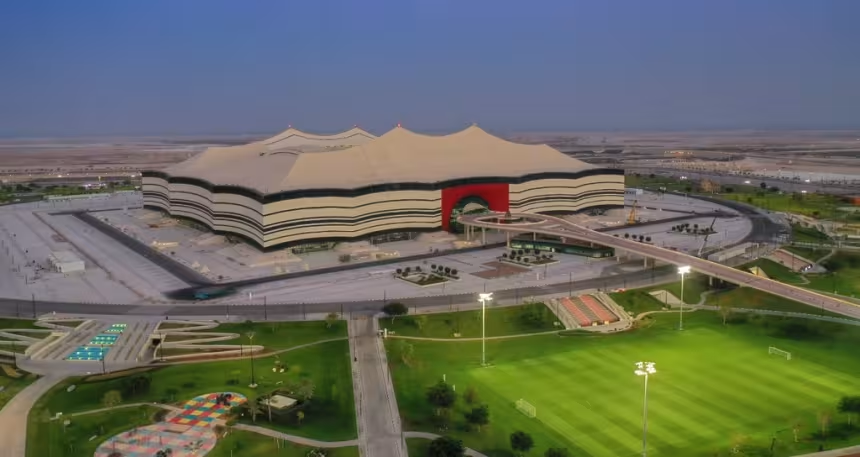
Countdown to FIFA Arab Cup 2021 Begins
DOHA - Countdown for the 10th edition of the FIFA Arab Cup has begun, which will be hosted by the State of Qatar for the second time in its history from Nov. 30 to Dec. 18, with the participation of 16 teams under the supervision of FIFA.
Preparations are currently in full swing to organize an ideal tournament that will be a rehearsal for the 2022 FIFA World Cup Qatar. The matches will be held on six of the eight World Cup stadiums, namely Al Bayt Stadium in Al Khor, Al Janoub Stadium in Al Wakrah, Ras Abu Aboud Stadium, Al Thumama Stadium, Education City Stadium and Ahmed bin Ali Stadium.
The FIFA Arab Cup returns in 2021 after a nine year hiatus. The last Arab Cup was held in Saudi Arabia in 2012, in which Morocco became champions after beating Libya 3-1 on penalties in the final match.
It is not strange for Qatar, which has hosted major global sporting events across all sports, to present an exemplary and distinct FIFA Arab Cup, as Qatar possesses the most modern sports facilities in the world and the capabilities that made it the center of international sports for many years.
The State of Qatar is known for its distinguished international organization in hosting many tournaments and events, which were praised by all athletes, visitors and sports officials in the world.
The FIFA Council officially approved the 2021 Arab Cup during the 15th meeting of the Council held at its headquarters in Zurich in March 2021.
FIFA President Gianni Infantino confirmed that the approval of the Arab Cup by the FIFA Council in Qatar 2021 was among the events that the State of Qatar will organize in preparation for the 2022 FIFA World Cup.
The best nine teams based on the FIFA World Ranking for Dec. 2021 will participate in the tournament, which qualified directly for the group stage, while the remaining 14 teams played in the preliminary round, and seven of them qualified for the group stage.
The group stage draw was held on April 27, 2021 in Katara Opera House, Doha. The group stage consists of four groups which includes four teams. The top two teams from each group will qualify for the quarterfinals, and the final match of the tournament will be held on Dec. 18, corresponding to the State of Qatar's National Day.
Group A of the FIFA Arab Cup consists of Qatar, Iraq, Oman and Bahrain. Group B consists of Tunisia, UAE, Syria and Mauritania. Group C consists of Morocco, Saudi Arabia, Jordan and Palestine. Group D will consist of Algeria, Egypt, Lebanon and Sudan.
The first edition of the Arab Cup was hosted in Lebanon in 1963. Tunisia won the first title of the Arab Cup. The Iraqi national team is the most winner of the Arab Cup with four titles. Saudi Arabia was crowned twice, while Tunisia, Egypt and Morocco each with one title.
Saudi Arabia hosted the last edition of the tournament in 2012, with the participation of 11 teams. Morocco won the tournament after defeating Libya in the final.
Jordan and Kuwait were the most participating teams in the tournament, as they each participated eight times, while Mauritania, Oman and the UAE were the least teams to take part in the tournament, with one participation for each.
Seven countries have hosted the Arab Cup. Kuwait and Saudi Arabia have each hosted twice, while Qatar, Lebanon, Iraq, Jordan and Syria have each hosted the tournament once.
The idea of organizing a championship for the Arab teams was launched from Lebanon, The first edition was held in 1963 in Beirut during the period between April 1-10, with the participation of five teams, which are Syria, Lebanon, Tunisia, Kuwait and Jordan. The Tunisian team won by obtaining seven points, after three victories and one draw. The Syrian team came second with six points, and the host Lebanese team came third with five points.
The former Lebanese player, Adnan Al Sharqi, was the first to score a goal in the tournament against Kuwait national team. The Arab Cup top scorer award went to Tunisian Sherif Tlemceni, after he scored five goals.
One year later, in 1964, the second edition of the FIFA Arab Cup was held in Kuwait City, from Nov. 13 to 20, with the participation of Kuwait, Jordan, Libya, Iraq and Lebanon only. The Iraq came first with seven points, while Libya came in second place with six points. The Iraqi player Hisham Atta Ajaj was crowned the tournament's top scorer after scoring five goals.
The third edition of the championship was held in 1966 in Baghdad from April 1 to 10. More teams participated in the tournament, unlike the previous editions, as 10 teams were divided into two groups. In the second group, the Iraqi team qualified after leading the group with seven points, and Lebanon qualified second with the same number of points in the same group.
The Libyan team led the first group with six points, and the Syrian team followed it with five points. After the first and second of the two groups qualified for the semi-finals, the Syrian team defeated Lebanon 1-0, and the Iraq team defeated Libya 3 -1. In the final, Iraq beat Syria with 2-1. Thus, Iraq won its second title in the Arab Cup. In the match for third place, the Libyan team defeated Lebanon 6-1. Libyan player Ali Al-Baski won the title of top scorer after scoring 10 goals.
The Arab Football Cup was halted for 16 years, then returned in 1982. Then it was decided that the tournament be held in Lebanon, but it was halted again due to the Israeli-Lebanese war after the Arab teams participated in the preliminary qualifiers. The tournament returned again and its fourth final qualifiers were held in Taif, Saudi Arabia, from July 3 to 12, in which six teams participated divided into two groups.
In the first group, Saudi Arabia qualified with four points, as well as Qatar with two points. In the second group, Bahrain and Iraq teams qualified with three points for each. In the semi-finals, Iraq defeated Saudi Arabia 3-2, and the Bahrain team beat Qatar 5-2 on penalty kicks, after the end of the match time with a goal for each. In the final match, Iraq defeated Bahrain 1-0. The third-placed teams were decided on penalties which ended 4-1 in favor of Saudi Arabia.
The fifth edition of the Arab Cup was held in the Jordanian capital, Amman, during the period from July 8 to 21, 1988, where ten teams participated. Jordan and Syria qualified from the first group with five points, and from the second group, Egypt qualified with six points, while Iraq qualified with five points. In the semi-finals, Iraq defeated Jordan 3-0. In the final, Iraq defeated Syria by penalty shootouts 43 after the match ended 11 draw, so Iraq won the fourth championship in a row. In the third-place match, Egypt defeated Jordan 2-0.
The sixth edition of the Arab Cup was held from Sep. 4 to 18, 1992, in Aleppo, Syria. Six teams participated in it and were divided into two groups. Egypt topped the first group with six points, and Kuwait came second with three points. In the second group, Saudi Arabia qualified with four points, and Syria with two. In the semi-finals, Saudi Arabia qualified after beating Kuwait 2-0 and Egypt qualified after beating Syria 4-3 by penalties.
In the final, Egypt defeated Saudi Arabia 32. In the third-place match, Kuwait beat Syria 21. The tournament's top scorer was the Kuwaiti player Hamad Al-Saleh, with three goals.
The seventh edition of the Arab Cup was held in Qatar in 1998, from Sep. 22 to Oct. 1, with the participation of 12 teams, the largest number in the history of this tournament. The teams were divided into four groups. The first from each group qualified for the semi-finals. Qatar qualified from group A with six points, Kuwait from group B with six points, the UAE from group C with three points and Saudi Arabia qualified with six points from group D.
In the semi-finals, Saudi Arabia beat Kuwait 2-1, and Qatar beat the UAE with the same result. In the final, the Saudi team defeated Qatar 3-1, and the UAE team defeated Kuwait 4-1 in the third-place match. Qatar's Mubarak Mustafa was chosen as the best player in the tournament, Saudi Arabia's Obaid Al-Dosari was the tournament's top scorer with eight goals, and Saudi Arabia's Mohammed Al-Deayea was chosen as the best goalkeeper in the tournament.
The eighth Arab Cup tournament was held in 2002 in Kuwait City again, from Dec. 16 to 30, with the participation of ten teams which were divided into two groups. From Group A, Jordan qualified with eight points and Morocco with five. From group B, Saudi Arabia qualified with ten points and Bahrain with seven. In the semi-finals, Saudi Arabia beat Morocco 2-0, and Bahrain beat Jordan 2-1. In the final, Saudi Arabia defeated Bahrain with the golden goal, after the match ended in a goalless draw.
The ninth Arab Cup tournament was held in 2012 in Saudi Arabia again from June 22 to July 6, with the participation of 11 teams which were divided into three groups. From group A, Saudi Arabia qualified with four points, and from group B, Morocco and Libya qualified with seven points. From Group C, Iraq qualified with seven points.
In the semi-finals, Libya beat Saudi Arabia 2-0 and Morocco beat Iraq 2-0. In the third and fourth-place match, Iraq beat Saudi Arabia 1-0 to achieve the third place. In the final match, Morocco defeated Libya 3-1 by penalties shootouts, after the original and extra time ended in a 11 draw, to win the first title in its history.
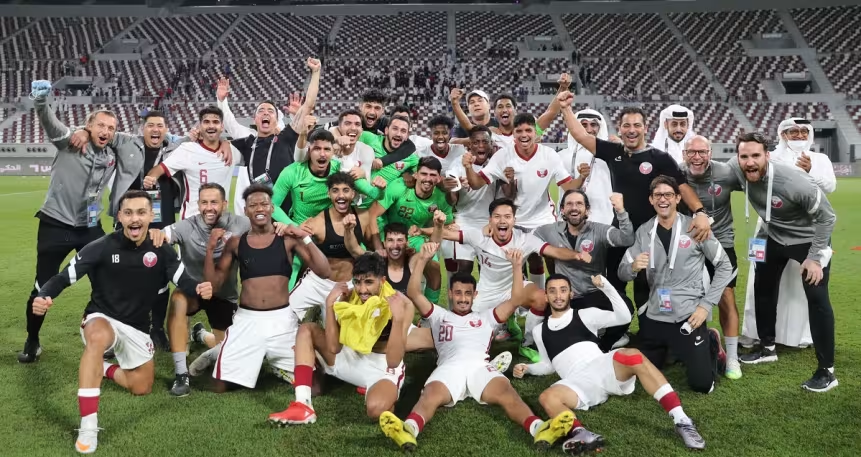
Team Qatar qualify for AFC U23 Asian Cup Uzbekistan 2022
Doha: Qatar booked a spot in the AFC U23 Asian Cup Uzbekistan 2022 following a 1-1 draw with Syria in their final Group A qualifying tie on Sunday.
The result took Qatar to seven points for top spot while Syria finished second on five but face a nervous wait to know whether they will advance as one of the best second-placed teams.
Yemen, meanwhile, ended their campaign with a 1-1 win over Sri Lanka in Group A's other match on Sunday.
Syria came into the tie needing three points to pip Qatar to the top spot and they started promisingly.
They pressed high in the opening minutes as Qatar were forced to defend deep and Syria's early aggression paid off when they took the lead in the 18th minute.
Qatar failed to cleanly clear a corner and the ball landed invitingly for Ali Bashmani, whose shot took a deflection before settling in the back of the net.
Stung into action, Qatar pressed forward and came close on several occasions but had to wait till the 45th minute for the equaliser.
A clumsy challenge by Diaa Alhak Al Mohammad saw Ahmed Al Ganehi brought down in the penalty area with Mohammed Waad sending the ball past a diving Mohamad Anas Al Bittar.
Syria held the major share of possession in the second half but the goal they needed eluded them as Qatar held on for a draw which assured them top spot in the group.
